
NEWS
One After Another! Another 18,500 DWT Chemical Tanker Launched
 TIME:2026-06-08 10:36
 AUTHOR:Wuhu Shipyard VIEWS:0
On June 6, 2026, a day bearing the auspicious meaning of "double six," the 18,500 DWT chemical tanker Hull No. 18531 reached an important milestone. Witnessed by the shipowner's representatives, classification society surveyors, and the company's project management, construction, technical, and quality inspection personnel, the vessel smoothly slid down and was successfully launched from Slipway No. 1.
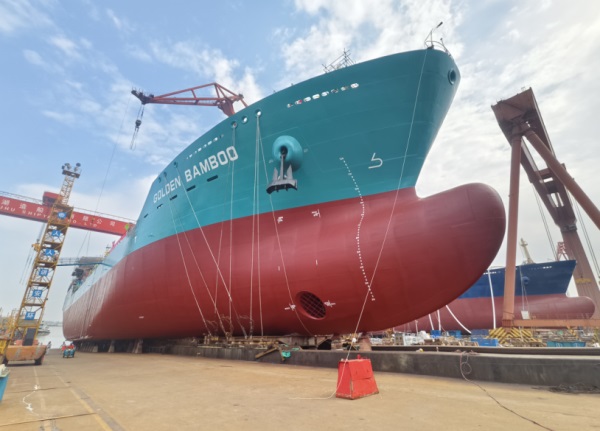
This vessel is a benchmark practice of the company's tandem construction method on the inclined slipway. Building on the mature construction experience of the 18500 series tanker, the project adopted the construction principle of "one vessel under construction, one vessel shifted, and one vessel placed on the berth," significantly improving slipway utilization and turnaround cycles. During the construction process, to address challenges such as a high tendency for steel plate welding deformation and cracking, a multi-layer, multi-pass symmetrical welding process combined with post-weld stress relief was implemented. The results were highly effective, eliminating welding defects. Through deepening lean production management, the team established the core objectives of "improving completeness, ensuring milestones, and optimizing quality." Prior to launching, key indicators such as main structure integration, installation of critical equipment, cable and piping laying, and pre-installation of deck machinery all reached extremely high standards, with some core areas approaching delivery-ready condition.
As the first vessel of the third series of 18,500 DWT chemical tankers, the project team strictly implemented modular construction and refined precision control throughout the slipway construction cycle, continuously deepening pre-outfitting and pre-installation processes, thereby significantly improving the overall construction efficiency of the vessel. Facing challenges such as multi-disciplinary cross-site construction and dense sequential operations, the various production workshops and construction teams worked in close coordination, overcoming difficulties while strictly controlling hull structure, welding quality, compartment tightness, and coating processes. All slipway construction tasks were completed on schedule with high standards and quality, ensuring the launching milestone was met as planned. This lays a solid foundation for the standardized, efficient, and pre-outfitting-oriented construction of subsequent vessels in the same series.

A CENTURY-OLD WUHU SHIPYARD,
REGARDING REVITALIZING THE NATIONAL SHIPBUILDING INDUSTRY AS OUR OWN DUTY
- Civilian Products
- Non-Ship Products
- PARTNER