
NEWS
Wuhu Shipyard's Real-Scene Intelligent Welding System Selected as MIIT 2025 AI Typical Case
 TIME:2026-07-07 11:03
 AUTHOR:Wuhu Shipyard VIEWS:0
Recently, the Ministry of Industry and Information Technology (MIIT) announced its list of 2025 Artificial Intelligence Application Typical Cases. The "Embodied Intelligent Welding Robot System Application for Heavy Industry Scenarios," jointly developed and implemented by Wuhu Shipyard, Xingjian Intelligent Robot, Lingyang Industrial Internet, and Xidian University, was successfully selected. It is one of only four cases from the entire province to make the list and the only AI industrial project in Wuhu to receive this national-level recognition.
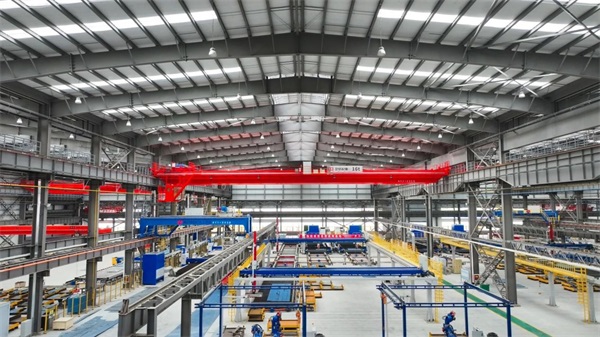
The company, addressing the practical pain points in its own hull section and sub-assembly mass production, collaborated with local robotics companies, provincial-level industrial internet platforms, and university research teams to conduct joint research and development. It opened up its core workshops for sub-assemblies and section fabrication, contributed its long-accumulated shipbuilding welding process database, and carried out joint scenario-specific technical adaptations, establishing a dedicated real-scene test base for shipbuilding manufacturing for this project.
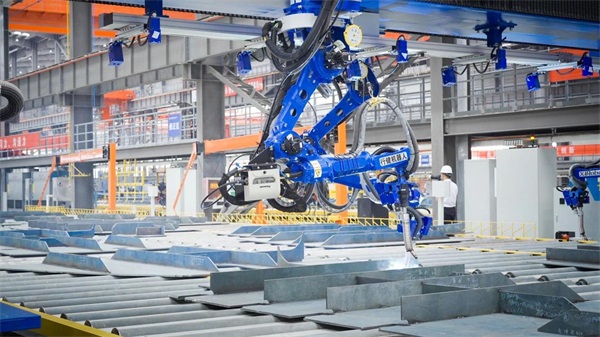
This AI composite vision intelligent welding robot system integrates multiple core technologies, including 3D vision perception, multi-machine collaborative planning, flexible autonomous programming, and 5G+ industrial internet. It breaks the traditional reliance on custom tooling, enabling "free workpiece placement and one-click start." The equipment uses 3D vision to autonomously scan and identify hull components, automatically calculate weld trajectories, and match standardized welding process parameters, eliminating the need for manual repetitive teaching.
The solution was first deployed in the section workshop for large-scale production. The robot can achieve continuous and stable welding over 100 meters; the deployment cycle for new production lines is shortened by 50% compared to traditional automated lines; the first-pass weld qualification rate reaches 99.2%; the welding rework rate decreases by 60%; and the overall production cost of the welding process is reduced by 30%. The system has obtained CCS Class Society WL4-level intelligent equipment certification, filling the gap in embodied intelligent welding equipment for the domestic shipbuilding sector. It has simultaneously established a standardized and replicable technical system, with a 78% localization rate for core vision and motion control components. This breaks the monopoly of foreign high-end welding equipment, strengthens the independent and controllable capabilities of the heavy-industry welding supply chain, and has begun exporting modular transformation models to the entire industry.
Moving forward, the company will continue to deepen the integration of artificial intelligence across the entire shipbuilding process chain, expand the coverage of intelligent welding robots, and continue to collaborate with industry-academia-research resources to incubate more intelligent manufacturing demonstration scenarios. Through hands-on practice in frontline shipbuilding scenarios, the company aims to accelerate the digital and intelligent transformation of the shipbuilding manufacturing industry.

A CENTURY-OLD WUHU SHIPYARD,
REGARDING REVITALIZING THE NATIONAL SHIPBUILDING INDUSTRY AS OUR OWN DUTY
- Civilian Products
- Non-Ship Products
- PARTNER