
NEWS
Delivery of the 6,600-ton Duplex Stainless Steel Chemical/Product Tanker(6606)
 TIME:2026-10-03 10:47
 AUTHOR:Wuhu Shipyard VIEWS:0
Recently, the 6,600-ton duplex stainless steel chemical/product tanker (6606) was successfully signed off and delivered. The vessel undertook a large number of technical verification and iteration tasks, posing extremely high challenges to project coordination, process implementation and quality control. Its successful delivery has paved the way and accumulated experience for the construction of subsequent vessels in the same series.
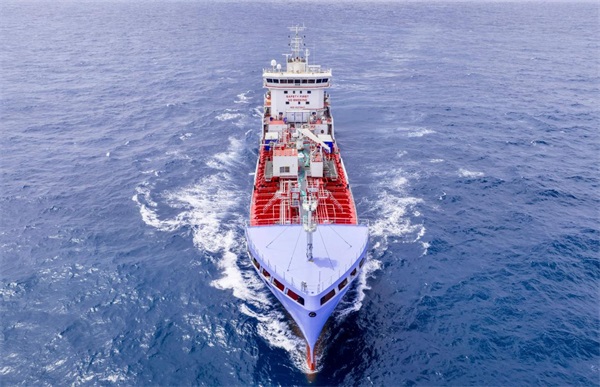
The vessel is equipped with two thermal oil boilers, one exhaust gas economizer and one steam boiler. With a large number of boilers and flexible medium switching, it has no traditional oil-fired water-tube or fire-tube main steam boiler, and can use both thermal oil and steam as heating media, significantly improving energy utilization efficiency. The boiler system is divided into primary heating and secondary heating, and integrates a complete piping system for cargo handling, heating, tank cleaning, nitrogen inerting, venting and overflow protection, and fire sprinkling, accommodating the operation of hazardous chemicals (MDI, TDI), petroleum products and edible cargoes, with a wide range of cargo adaptability and high vessel operating flexibility. The piping layout leading to the secondary heating station is particularly complicated, and its load balancing commissioning is highly challenging. After repeated tests and adjustments to the switching strategy, the project team finally achieved simultaneous operation of all systems with stable attainment of the specified temperatures.
The cargo system adopts an independent tank design, with a total of 12 cargo tanks made of 2205 duplex stainless steel, offering stronger corrosion resistance. Each tank can carry a different type of cargo, allowing 12 different cargo categories to be loaded separately. With the same number of tanks, it achieves tank independence and doubles cargo loading flexibility, meeting the high-cleanliness transport requirement of "one product, one tank." This design greatly enhances the vessel's adaptability in multi-cargo, small-batch transport scenarios and expands its operating scope.
The vessel adopts DC electric propulsion technology with a high degree of automation. The generator sets do not need to follow the ship's rotational speed/load to synchronize frequency; the generators can operate free from rotational speed constraints at the optimal fuel consumption speed point. When the ship is sailing at low speed, only one or two generators need to be running, keeping the generators always in a high-efficiency operating range. Compared with traditional AC electric propulsion and shaft-driven direct transmission, it delivers outstanding fuel savings under low-speed and variable-load conditions. DC networking eliminates the complex phase and frequency synchronization issues of AC synchronous grid connection, simplifies the logic for generator startup/shutdown, and provides fast dynamic response. Faced with the challenges of adapting the thrust bearing base to the engine room environment under this technology, as well as stringent grounding protection requirements, the project team carried out continuous testing and analysis. After more than 20 rounds of on-site collaborative efforts, they completed design modifications and upgraded the conductive components to a copper-silver composite structure, achieving stable and reliable grounding. The project systematically consolidated and locked in all technical experience accumulated during commissioning, and completed risk avoidance at the subsequent design stage.
During the construction process, the shipowner's team, drawing on its shipping operational experience, put forward many optimization suggestions focused on the vessel's practical performance. The project team turned each optimization requirement into valuable material for product iteration, and organized the process highlights, inspection criteria and actual vessel optimization suggestions accumulated during construction into a standardized process and template system, laying a solid foundation for the construction of subsequent vessels in the series.
Building one ship, enhancing a batch of capabilities, and driving a batch of vessels. The 6606 vessel extended from single-vessel delivery to series-wide empowerment, and transformed a one-time breakthrough into continuous capability upgrading, achieving the two-way implementation of technological accumulation and product output.

A CENTURY-OLD WUHU SHIPYARD,
REGARDING REVITALIZING THE NATIONAL SHIPBUILDING INDUSTRY AS OUR OWN DUTY
- Civilian Products
- Non-Ship Products
- PARTNER