
NEWS
18500DWT Chemical Tanker Wins CCS Carbon Footprint Evaluation Certificate
 TIME:2026-09-02 10:48
 AUTHOR:Wuhu Shipyard VIEWS:0
Recently, at the Anhui Ship Technology Exchange Conference, China Classification Society (CCS) awarded the country’s first carbon footprint assessment certificate for the 18500 DWT chemical tanker to the Company. This represents an important achievement of the Company in thoroughly implementing the national "Dual Carbon" strategy, marking a crucial step forward in its management of carbon emissions throughout the entire life cycle of ships.
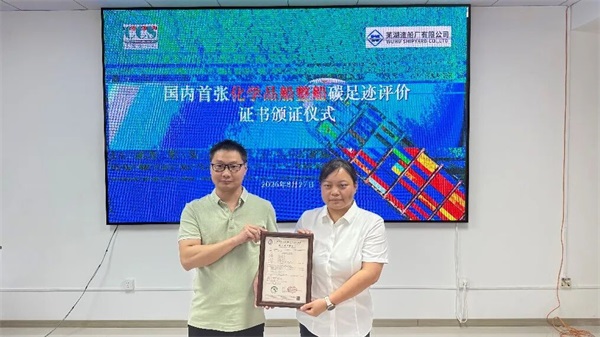
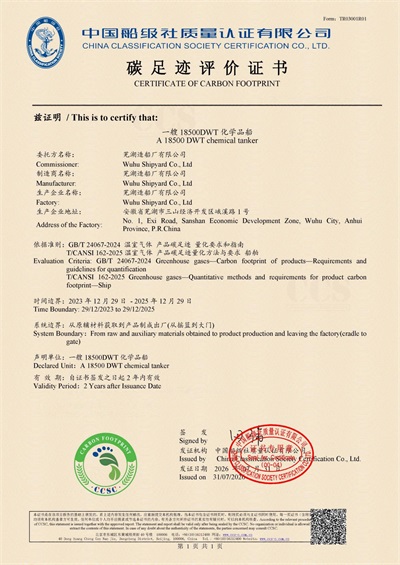
With the accelerated implementation of the International Maritime Organization’s (IMO) emission reduction strategy, vessel carbon footprint has become a key evaluation criterion for shipowner vessel selection, port access and shipping financing. This assessment was conducted in strict accordance with GB/T24067:2024 and T/CANSI 162-2025. The accounting scope covers the entire "cradle-to-gate" process, including raw and auxiliary material procurement, equipment manufacturing, material transportation, shipyard construction and vessel sea trials. It realizes quantitative assessment of greenhouse gas emissions at all ship stages, featuring standardized accounting methods and complete, reliable data.
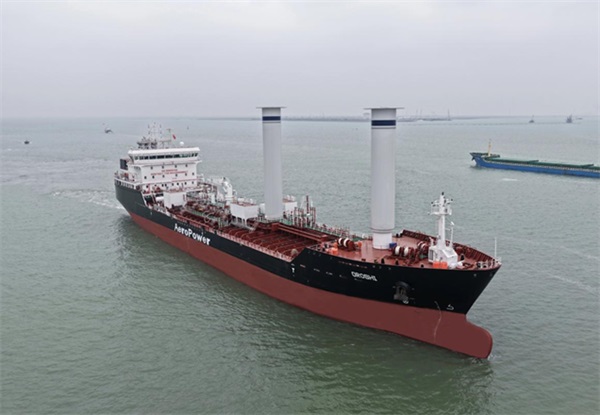
The 18500 DWT chemical tanker is a representative fine chemical carrier designed by Wuhu Shipyard. Hull form optimization has been adopted for this vessel to reduce sailing resistance and improve propulsion efficiency. Equipped with two sets of rotor sail systems, it can cut energy consumption by 5%–25% and reduce fuel consumption by up to approximately 10%. The ship is reserved with space for retrofitting methanol clean fuel, complying with the International Maritime Organization’s Carbon Intensity Indicator (CII) rules for international shipping, and meeting the needs of operational cost reduction as well as low-carbon emission reduction.
In addition to the 18500 DWT chemical tanker that obtained the certificate in this project, the Company has completed carbon footprint accounting for the 22,000-ton chemical tanker, 14,600-ton multi-purpose heavy-lift vessel and large fracturing vessel. A complete carbon emission inventory and reporting system has been established, providing a data foundation for the iterative optimization of ship types.
Adhering to the development strategy of "Green Shipbuilding and Building Green Ships", the Company insists on controlling low-carbon performance from the design source. Through hull form optimization, energy consumption management, application of energy-saving devices and adoption of clean energy power, it achieves improved energy efficiency and carbon emission reduction throughout the whole life cycle of vessels.
The Company has now built a comprehensive green ship product matrix and delivers integrated sustainable shipping solutions. It has laid out multiple technology routes covering battery-electric, LNG, methanol, ammonia and hydrogen propulsion, and has completed the R&D and construction of a series of green vessels and offshore engineering equipment. In parallel, it is developing an intelligent navigation cockpit and a self-developed navigation chip. Through intelligent energy efficiency management and dynamic voyage route optimization, it continues to tap into the energy-saving potential of vessels.
Its subsidiary, Tri water New Energy Technology, focuses on the field of inland new energy vessels and has built a product portfolio of cargo ships, tourist vessels and houseboats. It covers a variety of power solutions including pure battery power, methanol-battery hybrid power and battery swapping, helping advance the green transition of inland waterway shipping.
In terms of green shipbuilding, the Company has made multi-pronged efforts to advance low-carbon development. It promotes water-based and high-solids environmentally friendly coatings, and improves the closed-loop treatment of waste gas, waste water and solid waste. It drives technological innovation to boost the upgrading of intelligent ship manufacturing. Distributed photovoltaic and energy storage facilities are constructed to raise the proportion of green power consumption. Initiatives such as building-integrated photovoltaics (BIPV) and paperless office have been implemented to embed green and low-carbon concepts into the company’s daily operations.
The acquisition of the CCS carbon footprint certificate fully affirms Wuhu Shipyard’s green development practices. Going forward, the Company will continue to improve its carbon footprint management system, deepen R&D in cutting-edge technologies such as green ship design, alternative fuel applications, and carbon capture. It will benchmark against international standards, seize opportunities in the zero-carbon transition of shipping, and contribute to the high-quality development of China’s shipbuilding industry and the achievement of the "Dual Carbon" goals.

A CENTURY-OLD WUHU SHIPYARD,
REGARDING REVITALIZING THE NATIONAL SHIPBUILDING INDUSTRY AS OUR OWN DUTY
- Civilian Products
- Non-Ship Products
- PARTNER